
Most gym owners find out they got this wrong after the equipment is already bolted down.
The machines are in. The floor is done. And now the treadmill row feels like a hallway and nobody can use the squat rack without bumping into someone on the cable machine. At that point your options are expensive.
So let’s get ahead of it.
Square footage lies to you
The number on your lease doesn’t tell you much.
A 4,000 sq ft space sounds generous until you subtract the locker rooms, the front desk, the bathrooms, the hallways, and the unusable corners. What you actually have to work with is usually 60 to 70 percent of that number.
So if you’re planning a 4,000 sq ft gym, budget your layout around 2,400 to 2,800 sq ft of usable floor. Everything else is support space.
The real numbers by equipment type
These are minimum clearances. Meaning: this is what each piece of equipment needs to function safely, not comfortably.
Cardio
- Treadmill: 20 sq ft footprint + 3 ft rear clearance. Budget 30 sq ft per unit.
- Elliptical: 20 to 25 sq ft per unit.
- Stationary bike (upright or recumbent): 10 to 15 sq ft per unit.
- Rowing machine: 20 sq ft in use, but you need the length. About 8 ft of clearance in front.
Strength (selectorized / plate-loaded machines)
- Single-station machine: 35 to 50 sq ft depending on the footprint.
- Cable crossover or functional trainer: 100+ sq ft when you count the swing radius and the user’s range of motion.
Free weights
- Flat bench with barbell: 50 sq ft minimum.
- Squat rack or power cage: 50 to 60 sq ft. More if you’re allowing spectators or coaching.
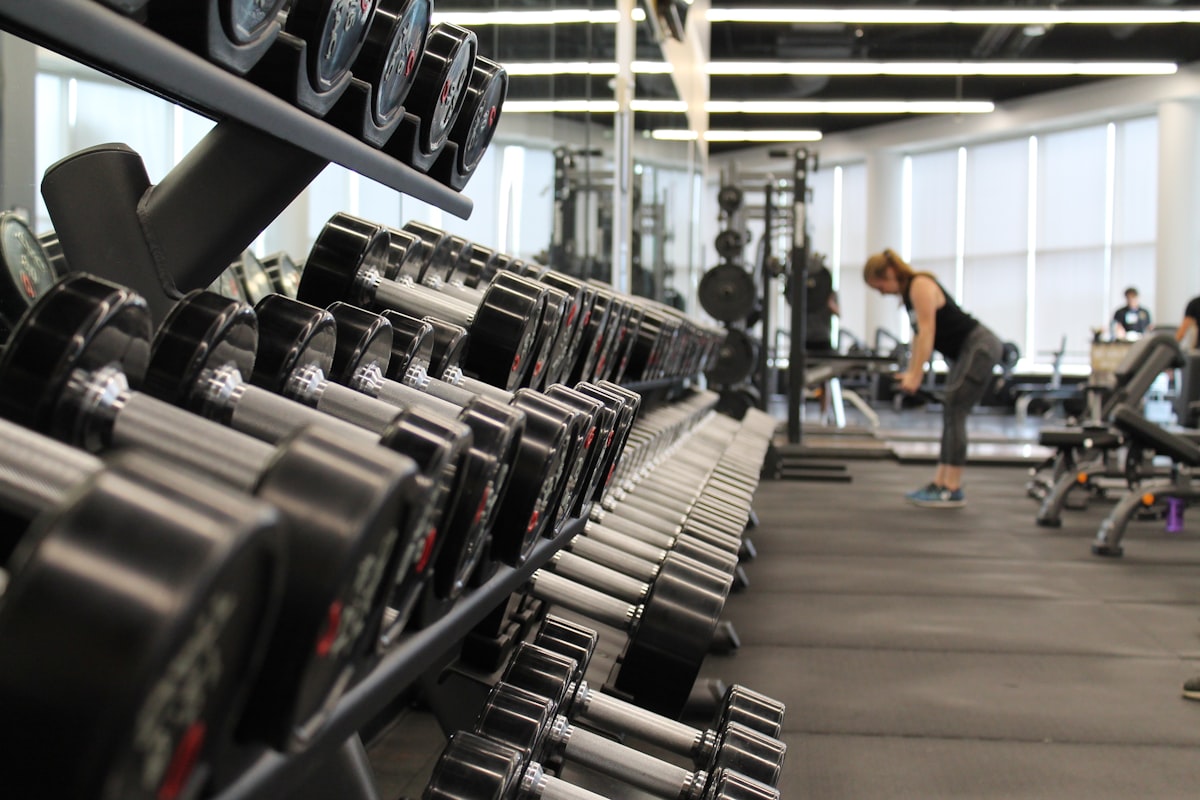
- Dumbbell rack (standard wall-mounted): 10 sq ft per linear foot of rack, plus 8 to 10 ft of clear space in front for users.
Functional / open training zones
This depends entirely on programming. A single turf lane for sleds runs about 10 ft wide by 40 ft long. If you’re building a functional training area, plan for at least 400 to 600 sq ft.
A simple formula to check your plan
Take your total equipment count. Assign each piece its budget from the list above. Add them up.
That number should not exceed 60 percent of your usable floor space.
The remaining 40 percent is circulation: the paths members take to move between stations, the space needed to load and unload barbells, the gap that keeps a spotter from stepping on someone doing cable rows.
If your equipment total is pushing past that 60 percent threshold, you don’t have a space problem. You have a selection problem. Something has to come out or get replaced with a smaller footprint option.
Where people get it wrong
The most common mistake is planning equipment placement without planning traffic flow.
You can have perfect clearances on every single machine and still end up with a layout that feels chaotic because the path from the entrance to the free weight area cuts through the cardio zone. Or the water fountain is behind the squat racks. Or the only way to the bathroom runs through the stretching space.
Good gym layout is basically traffic engineering. The equipment is the buildings. The aisles are the roads. And the goal is to move people through the space without creating intersections.
When it’s worth getting a second set of eyes
If you’re working with an irregular floor plan, multiple training zones, or you’re trying to fit a commercial load into a smaller boutique space, the math gets complicated fast.
I do equipment layout and floor plan consulting for gyms at every stage, from new builds and renovations to existing spaces that just aren’t working the way they should.
If you’ve got a floor plan you’re not sure about, I’m happy to take a look. Get in touch here.
Fit Design Plus works with gym owners and operators to design functional, safe, and scalable equipment layouts. Based in Wichita Falls, TX.